
Explore our boiler blog for expert insights, industry updates, and valuable tips on boiler maintenance, efficiency, and more.

Explore our boiler blog for expert insights, industry updates, and valuable tips on boiler maintenance, efficiency, and more.
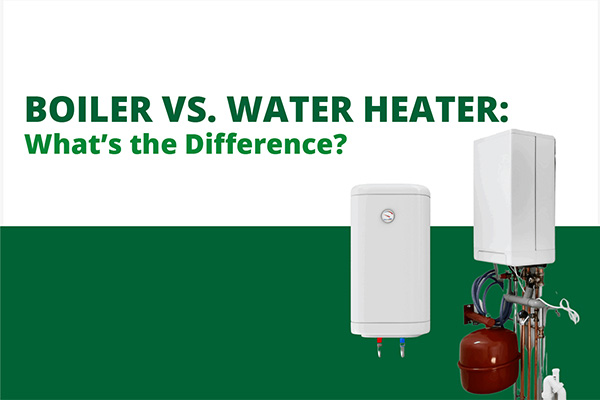
If you’re trying to decide between a boiler and a water heater, here’s the clear answer upfront:
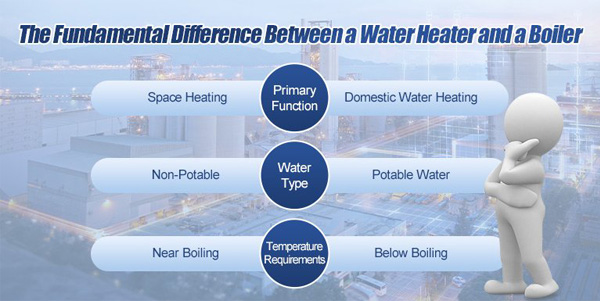
A boiler is designed for space heating (and can also provide hot water), while a water heater is specifically built to supply domestic hot water for everyday use.
In short:
- Need heating for your building? → Choose a boiler
- Only need hot water for showers, sinks, or appliances? → Choose a water heater
However, the real decision involves more than just function. You also need to consider cost, efficiency, installation complexity, and long-term usage. In this complete 2026 guide, we’ll break down everything you need to know—from working principles to real-world applications—so you can confidently choose the right system.
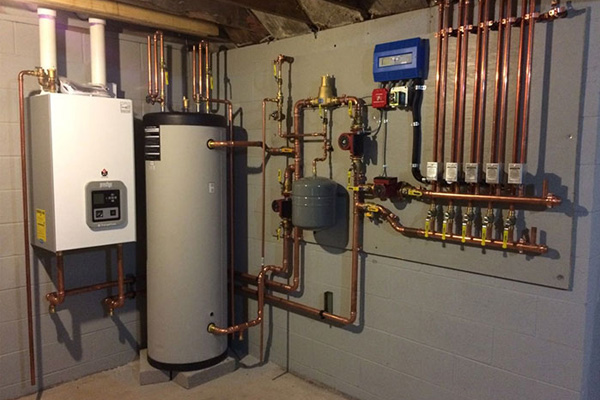
A boiler is a heating system that warms water and distributes it as either hot water or steam to provide heat throughout a building.
A boiler heats water using fuel (gas, oil, electricity, or biomass). The heated water or steam is then circulated through:
This creates a closed-loop system, meaning the same water is reused rather than constantly replaced.
A water heater is a system designed solely to heat water for daily use, such as bathing, cleaning, and cooking.
Water heaters either:
Unlike boilers, water heaters operate in an open system, meaning fresh water enters and is used continuously.
| Feature | Boiler | Water Heater |
|---|---|---|
| Primary Function | Space heating + optional hot water | Domestic hot water only |
| Output | Steam or hot water | Hot water |
| System Type | Closed-loop | Open system |
| Efficiency | High (especially condensing models) | Moderate to high |
| Installation Cost | Higher | Lower |
| Best Use Case | Heating systems | Daily water usage |
Key takeaway: Boilers are ideal for heating entire spaces, while water heaters are best for supplying hot water on demand.
Boilers generally have a higher upfront cost due to:
Water heaters are more budget-friendly, especially for residential use.
Boiler installation often involves:
Water heaters are much simpler and faster to install.
Energy efficiency depends heavily on how the system is used.
Key Insight:
Pros
Cons
Pros
Cons
Hotels, hospitals → Often use both systems together
Boilers are essential, especially where heat or steam is required
Simple rule:
If heating is involved, choose a boiler. If not, a water heater is sufficient.
A homeowner installed a boiler thinking it would cover all heating and water needs efficiently. However, the property didn’t require central heating, resulting in unnecessary installation and operating costs.
After switching to a tankless water heater:
This highlights the importance of matching the system to your actual needs.
The difference between a boiler and a water heater ultimately comes down to purpose and application.
Choosing the right system requires balancing functionality, cost, and efficiency. By clearly identifying your requirements, you can invest in a solution that delivers long-term performance and value.
Yes, a boiler can provide hot water, but it is often not the most cost-effective solution if you only need domestic hot water.
It depends on usage. Boilers are more efficient for heating, while water heaters are better for daily hot water use.
In many commercial or large residential settings, using both systems ensures optimal performance and efficiency.

We have more than 20 years of experience in boiler system equipment research and development and manufacturing. And committed to designing and producing boilers that suit your needs, including fire-tube, water-tube, and steam boilers, while also staying up-to-date with the latest technological boiler.
Get in touch
Copyright © Zhengzhou Dabonn Energy Co., Ltd


